
What Is a Vision System? A Plain-English Guide to Machine Vision in Manufacturing
Vision systems give production lines eyes: cameras, lighting and software that inspect every product in real time. Here's how they work, what they're used for, and when they make sense.
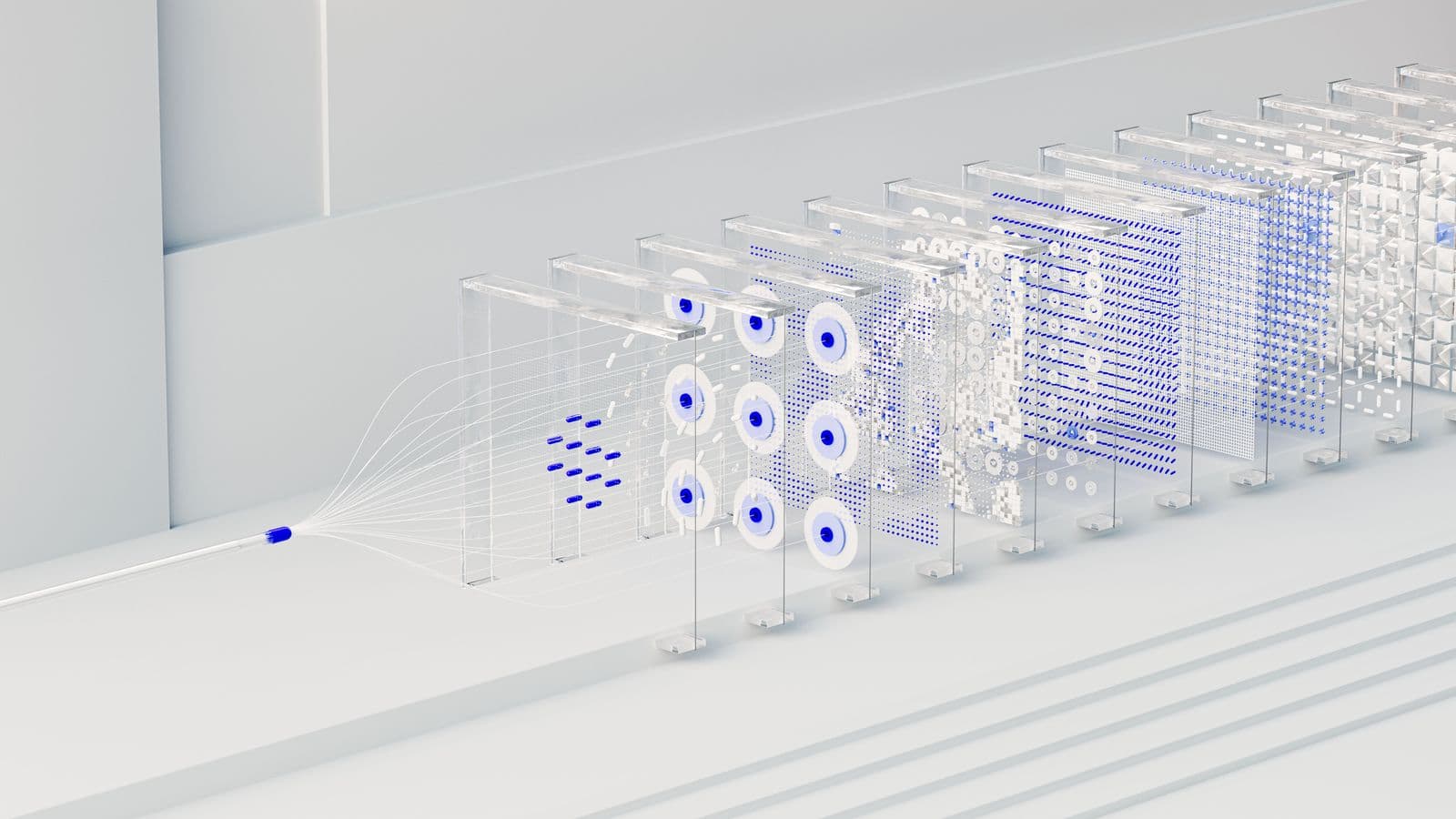
Walk through almost any modern factory — a bakery, a pharma packaging hall, a bottling plant — and somewhere on the line you'll find a camera in a metal housing, staring at products flying past at several pieces per second. That camera, together with its lighting, optics and the software behind it, is a vision system. It's one of the least glamorous and most useful pieces of automation on the market, and the industry around it is far from niche: analysts put the global machine vision market at roughly 13–15 billion USD in 2025, growing at 7–9 % a year. This article explains what a vision system actually is, how it works, and where it earns its keep.
Vision system, machine vision, computer vision — what's the difference?
The terms get mixed up constantly, so let's untangle them:
- Computer vision is the broad research field: teaching computers to extract meaning from images. It covers everything from medical imaging to self-driving cars.
- Machine vision is computer vision applied to industrial tasks — inspection, measurement, guidance, identification — usually in real time and under controlled conditions.
- A vision system is the concrete, deployed package: camera(s), lens, lighting, a processing unit and software, integrated with the machine or line it serves.
In other words, computer vision is the science, machine vision is the discipline, and a vision system is the thing bolted above your conveyor.
What is a vision system used for?
Most industrial applications fall into four families, often abbreviated GIGI — guidance, identification, gauging, inspection:
- Inspection — the classic use case. Is the product complete? Is the surface free of cracks, dents, contamination? Is the seal intact, the cap on straight, the blister fully filled? The system sorts every piece into OK or NOK.
- Identification — reading barcodes, DataMatrix codes, printed text (OCR) such as lot numbers and expiry dates, and verifying that the right label is on the right product.
- Gauging (measurement) — non-contact measurement of dimensions: diameter, gap, fill level, position of a component, all to fractions of a millimetre.
- Guidance — telling a robot or actuator where something is, so it can pick, place or align it.
Counting is a fifth, humble but common task: how many biscuits in the tray, how many bottles in the crate, how many pieces went past this shift.
The economic argument is simple. Humans are surprisingly poor at repetitive visual inspection: studies of manual inspection tasks report error rates of 20–30 %, and performance degrades further with fatigue, shift changes and line speed. A vision system inspects piece number 100,000 with exactly the same attention as piece number one — and it never looks away.
A vision system doesn't replace quality control — it makes 100 % inspection possible. Instead of sampling one piece in a hundred, you check every single product, at full line speed, with consistent criteria on every shift.
How a vision system works, step by step
Every vision system, from a smart sensor to a multi-camera cell, runs the same basic loop:
- Trigger. A photoelectric sensor, encoder pulse or PLC signal tells the system "a product is in position now". At typical line speeds, the timing window is a few milliseconds.
- Image acquisition. The camera captures a frame. Exposure time, lens choice and — above all — lighting determine whether the defect is even visible in the image. Backlight for silhouettes and fill levels, low-angle light to make scratches pop, diffuse domes for shiny foil: lighting design is half the job.
- Processing. Software analyses the image. Classic rule-based tools measure edges, count blobs, match templates and read codes. Deep-learning models classify products or flag anomalies, which is far more robust for organic, variable products — bread, meat, natural wood — where no two "good" pieces look identical.
- Decision. The result is condensed to something actionable: OK/NOK, a measured value, a decoded string.
- Action. The system tells the line what to do — fire a pneumatic ejector to reject the NOK piece, stop the machine, or simply log the result. This is why integration with the PLC (or using a controller that is itself an AI-capable PLC) matters as much as the AI.
All of this typically happens in tens of milliseconds. If your line runs at three pieces per second, the whole loop — trigger to reject — has about 300 ms of budget, minus mechanical delays.
Rule-based versus AI: two ways to "see"
Traditional machine vision is deterministic. You define rules: this edge must be here ±0.2 mm, this region must contain at least N dark pixels, this code must decode. It's fast, explainable and excellent for geometry, measurement and code reading — and it's been running reliably in factories for four decades.
Its weakness is variability. Rule-based systems struggle when good products naturally vary (food is the classic example), when lighting drifts, or when defects can't be exhaustively described in advance.
Deep learning flips the approach: instead of writing rules, you show the model examples. Train it on photos of OK and NOK pieces and it learns what "good" looks like — including all the harmless natural variation. Anomaly-detection models go further and need mostly OK images, flagging anything that deviates. Recent benchmarks consistently show deep-learning approaches outperforming template matching and hand-tuned rules on robustness to lighting changes and product variation, at the cost of needing training data and more compute.
In practice, modern systems combine both: rules for measurement and codes, neural networks for surface defects and classification. And thanks to edge AI hardware, the inference runs directly on the line — no cloud connection, no latency, no production images leaving the plant, which quality and IT departments in food and pharma appreciate.
What deployment actually looks like
A realistic project, whether you build it yourself or use a camera-based inspection subscription like Robopipe, follows roughly this path:
- Define the defect. Collect real NOK examples and agree with quality what counts as a reject. Vague criteria ("looks bad") are the number-one cause of failed projects.
- Fix the imaging. Mounting position, lens, lighting, shrouding against ambient light. In wet areas and washdown environments, IP-rated housings are non-negotiable.
- Collect data and train. For AI-based inspection, a few hundred to a few thousand images are usually a workable starting point; the model then improves as operators confirm or correct borderline cases.
- Integrate with the line. Trigger input, reject output, and ideally OK/NOK counts flowing into your MES or a simple dashboard so the numbers are visible beyond the line itself.
- Validate and hand over. Run the system in shadow mode alongside manual inspection, compare results, tune the threshold between false rejects and escapes, then let it take over.
The hardware has become dramatically cheaper — an industrial camera and an edge AI unit cost a fraction of what a vision cell cost a decade ago. The remaining effort is in lighting, data and integration, which is exactly why turnkey and subscription models have emerged: they shift that engineering burden off the plant team.
The bottom line
A vision system is nothing mystical: a camera, well-designed lighting, software that turns pixels into an OK/NOK decision, and an output wire that acts on it within milliseconds. What has changed recently is that deep learning handles variable, organic products that defeated rule-based tools, and that edge hardware made 100 % inspection affordable for mid-sized plants, not just automotive giants. If you're still relying on sampling and tired human eyes at the end of your line, it's worth measuring what escapes today cost you — that number, compared against a modern vision system, usually settles the discussion quickly.